
AI news · October 12, 2026
Sakana's MASS trains models on their own multi-agent workflows
Sakana's MASS trained from 12 synthetic tasks and reached a reported 69.9% held-out win rate over its base model; the code is available, but SWE-bench transfer fell below baseline.
- synthetic tasks in the reported suite
- 12
- second-round win rate over base on held-out tasks
- 69.9%
- reported SWE-bench score per token versus base
- 0.94×
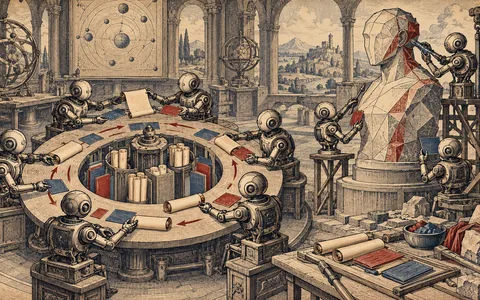
Sakana's Multi-Agent Self-Supervision, or MASS, uses one shared model as task solver, workflow optimizer and evaluator. It first searches for a better way to divide work among agents, then trains on the selected multi-agent trajectories and repeats the cycle. The published implementation starts from Qwen3.6-27B and reports two rounds over 12 synthetic research tasks. On held-out tasks, the second round won 69.9% of comparisons against the base; score per output token rose 1.2–1.6x on several research benchmarks.
The limit is visible in the same report: score per token was 0.96x on Terminal-Bench and 0.94x on SWE-bench Verified. That uneven transfer is more useful than a blanket success claim. The code is a research implementation, not a hosted model, and the real run needs a model server and GPU allocation. For a maker, the practical idea is to improve the workflow and the model together, while keeping an outside evaluator to catch self-reinforced mistakes.
What you can do with it
Clone the repository and run its plan command and offline tests first; those steps need no GPU or model server. If the idea fits your work, try one bounded task with a fixed evaluator, saved trajectories and a cost cap. Do not train on self-judged wins until an outside check confirms the improvement.
Our take
MASS is interesting because it treats agent coordination as training data instead of prompt decoration. The 69.9% result is encouraging, but the weaker coding transfer shows why a research benchmark does not settle product value. The best near-term use is to borrow its workflow-search idea for internal evaluations, not to promise self-improving software.
Links Try itResearch overview
Source: Sakana AI / UC Berkeley — Made With Models writes the brief; the reporting is theirs.